Once upon a time we were a country and a society that fought for progressive ideas. I know because I documented it just over a decade ago when I wrote and edited my book, Wisdom of Progressive Voices. My idea was to track the history, to tell brief bios on those great Americans who envisioned a better country and world for all of us and to provide some inspiring words.
Wisdom of Progressive Voices was published in 2010 after I saw my beloved native state of Wisconsin elect Scott Walker governor. Within weeks of taking office in 2011, Walker basically destroyed over a hundred years of progressive history – Fighting Bob LaFollette, William Proxmire, Earth Day Founder Gaylord Nelson – within weeks.
I tried to sound the alarm and warn that Wisconsin was just the first step. If we forgot our history…if the Democratic Party couldn’t remember its FDR roots or the likes of Henry Wallace and Paul Wellstone, then well, then things would become really difficult.
Recently, as I began to start the “uncluttering” process in my house, I came across a box and said, ‘what’s in there?’ To my surprise I still had one box of Wisdom of Progressive Voices, shipped to me from my printer a few years back. Much like the progressive movement, it was forgotten and dusty.
So what to do with these books?
I decided why not try to offer them to anyone who might want to have documentation of a time in which we tried hard to make this a better world and planet for all. So in these days of supply chain problems, I offer up the chance to purchase the book. NO SHIPPING CHARGES. Sent to you via the United States Postal Office and with a promise that all proceeds will be turned over to a handful of organizations still trying to keep alive the progressive spirit, for example, The Daily Poster, BradBlog, Common Dreams.
Check out the offer below and hold on to history and hope.
Education has always inspired fear among those who want to keep the existing distributions of power and wealth as they are.”
– Howard Zinn
I’m not sure we can write anything better to sum up the social and moral tragedy of this past weekend than the blog posted by the great Juan Cole, professor of history at the University of Michigan. In case you missed the event referenced, students from an all-male Catholic high school in Covington, KY surrounded a Native American protest in Washington, D.C., intimidating Native Americans gathered for the first-ever Indigenous People’s March, at the Lincoln Mall. That demonstration was designed to call attention to the global injustices faced by Native communities, including:
The epidemic of missing and murdered Indigenous women
An “environmental holocaust” on Indigenous lands
Voter suppression
Police brutality
These students, part of a larger group of Catholic high schoolers, were gathered in Washington that same day for a “March For Life” at the National Mall. No matter how media and others try to spin the story, the fact that MAGA-hat and T-shirt wearing Catholic male high school students found themselves smirking and laughing at elder and Vietnam War veteran Nathan Phillips (or using racist terms like ‘Black Muslims’) illustrates many things of what happens when we fail as a society in the realm of investing in education.
One key topic in Cole’s article, entitled The Stupidity of Evil: Teens Shouting ‘Build that Wall at Native American, that caught our eye was the emphasis on that failure – both individually and institutionally – to effectively teach history to the next generation (Just what does a history class or religion class at Covington Catholic High School look like?) One of Cole’s observations is:
How stupid do you have to be to chant “build the wall” at a Native American whose people were here at least 13,000 years ago before the European undocumented migrants showed up in their lands?
How stupid do you have to be as a Catholic not to know that anti-immigrant slogans like “Build the Wall” and “Make America Great Again” are the descendants of the racist slogans (such as “Keep America American”) that white Protestants of the 19th century ‘Know Nothing’ secret society chanted at Catholic immigrants from Ireland and Italy and Germany just before they burned down Catholic churches?
We have written countless times over the years in our newsletter and on our website lamenting the demise of education, history (and civics), and liberal arts within our society over the past 40 years. This demise includes everything from defunding our public schools to listening to right-wing pundits laud former Wisconsin Governor Scott Walker’s appeal to voters as being rooted in the fact that the non-college educated Walker didn’t carry the “elitist baggage” of higher education.
How do we become “stupid?” One of the ways is we forget our history and our history of supporting public education (who among us doesn’t have an immigrant ancestor who went to night school to learn). Another way is to downplay the importance of liberal arts education – to teach us the skills of logic and critical thinking. “Education for education’s sake.” It cannot be stated enough. We are the fruits of what we have sown.
To sum up his article, Cole writes:
Nathan Phillips said he is afraid for where the country of going because of the wave of hatefulness sweeping the country.
He is too polite to blame Trump for our collective national two minutes of hate, but I’m not. This incident was Trump’s fault.
Mean boys in high school acting out evil may be a bit banal as well. But if Nathan Phillips is apparently afraid that hatred is contagious, I am afraid that stupidity might be an infectious disease.
One of the many reasons we are where are today is that we have forgotten the importance of history and education. Another is, we have forgotten our souls and how to love.
We are reminded of a nun who taught history years ago who once remarked: “98 percent of the world’s problems could be solved with love…the other 2 percent with semantics.”
Or in the month when we honor the legacy of Dr. Martin Luther King, Jr., it would serve us well to remember his famous words: ”Darkness cannot drive out darkness; only light can do that. Hate cannot drive out hate; only love can do that.”
“This is the moment when people start to realize that global warming is not a problem for future generations, but for us now.”
– Johan Rockström, Stockholm Resilience Center
You may have missed the incredible amount of recent headlines on climate change. The sheer volume of climate-change related stories that “crossed our desk” within a 48-hour time period was stunning (to put it mildly). This news, however, that will have dramatic impact on our planet and the very existence of life as we know it, appears to be unable to break through the non-stop Orwellian speak that emanates from just about everywhere these days. To coin an old phrase, it appears we are fiddling while we literally are burning.
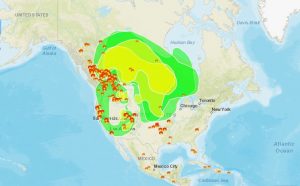
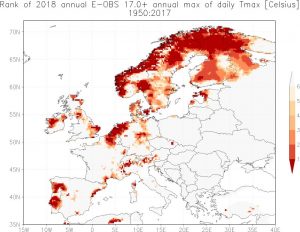
The one story that has penetrated the news cycle to some degree has been the reports on the wild fires in California, which are still causing havoc across the state. But California is not alone. Wild fires in the arctic circle, Canada, and the Pacific Northwest; Japan under sweltering heat; Europe recording temperatures never seen before. And anecdotal stories from friends and family about rain storms that stall causing downpours that dump 8-10 inches of rain at a time.
Welcome to the United States of smoke.
We were so astonished at the never-ending climate change stories in a two-day period that we thought we would share a digest of some of the headlines we saw…ICYMI.
Wildfire Smoke Is Smothering the US—Even Where You Don’t Expect It: “America is on fire … again. More than a million and a half acres are burning in 15 states, from Arizona to Alaska. More than 3,000 firefighters are working to contain the Mendocino Complex Fire 100 miles north of San Francisco, now the largest in California history, and over the weekend, lightning strikes sparked dozens of new wildfires across the state of Washington…
“…While wildfires are geographically limited by nearby fuel sources, wildfire smoke goes wherever the wind takes it. Carried on eastward-flowing air currents, dangerous particulate matter from wildfires is increasingly smothering large swathes of the US, causing health scares wherever these air pollution spikes hit. Welcome to the United States of Smoke.
“…But other scientists have found evidence that the wildfire smoke public health problem is only going to get worse as the west gets hotter and drier. A 2016 study predicts that climate change will drive almost 60 percent more “smoke waves”—or multiple days of high particulate pollution from wildfires—across much of the US by 2050.”
National Geographic reports: Exclusive: Some Arctic Ground No Longer Freezing—Even in Winter: “Every winter across the Arctic, the top few inches or feet of soil and rich plant matter freezes up before thawing again in summer. Beneath this active layer of ground extending hundreds of feet deeper sits continuously frozen earth called permafrost, which, in places, has stayed frozen for millennia.
“But in a region where temperatures can dip to 40 degrees below zero Fahrenheit, unusually high snowfall this year worked like a blanket, trapping excess heat in the ground. They found sections 30 inches deep—soils that typically freeze before Christmas—that had stayed damp and mushy all winter. For the first time in memory, ground that insulates deep Arctic permafrost simply did not freeze in winter…some Arctic experts are weighing a troubling question: Could a thaw of permafrost begin decades sooner than many people expect in some of the Arctic’s coldest, most carbon-rich regions, releasing trapped greenhouse gases that could accelerate human-caused climate change?”
Common Dreams provides information on the report: What Lies Beneath: The Understatement of Existential Climate Risk: In it, the report released Monday… argues that the reticence of the world’s scientific community—trapped in otherwise healthy habits of caution and due diligence—to downplay the potentially irreversible and cataclysmic impacts of climate change is itself a threat that should no longer be tolerated if humanity is to be motivated to make the rapid and far-reaching transition away from fossil fuels and other emissions-generating industries.
The warming Arctic
In the new report—titled What Lies Beneath: The Understatement of Existential Climate Risk authors David Splatt and Ian Dunlop, researchers with the National Centre for Climate Restoration (Breakthrough), an independent think tank based in Australia, argue that the existential threats posed by the climate crisis have still not penetrated the collective psyche of humanity and that world leaders, even those demanding aggressive action, have not shown the kind of urgency or imagination that the scale of the pending catastrophe presents.
Common Dreams also carried ‘Hothouse Earth’ Co-Author Says ‘People Will Look Back on 2018 as the Year When Climate Reality Hit’ in which meteorologist Eric Holthaus said: “Yes, the prospect of runaway climate change is terrifying. But this dead world is not our destiny. It’s entirely avoidable…As the authors of the paper have argued in response to the coverage, implying otherwise is the same as giving up just as the fight gets tough.”
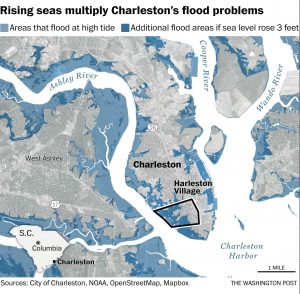
The Washington Post reports on Sea level rise is eroding home value, and owners might not even know it. On a broad scale, the effect is subtle, the studies show. The sea has risen about eight inches since 1900, and the pace is accelerating, with three inches accumulating since 1993, according to a comprehensive federal climate report released last year. Scientists predict the oceans will rise an additional three to seven inches by 2030, and as much as 4.3 feet by 2100.
Meanwhile, mapping has become increasingly precise, providing near-exact elevations that let researchers predict when individual properties could be underwater.
And the pièce de résistance from Chris Hedges. Saying Goodbye to Planet Earth “This tiny span of time on a planet that is 4.5 billion years old is known as the Holocene Age. It now appears to be coming to an end with the refusal of our species to significantly curb the carbon emissions and pollutants that might cause human extinction.”
And this is but a handful of the stories. Climate change – the story we want to ignore and, in some cases, deny. And who can blame anyone for that? But denial and avoidance – in the end – will not make the science of climate change go away. Yes, we can all do our individual tasks to help as we can. But the crisis we face demands large-scale, global, governmental intervention. It’s what government was designed to do and in decades past did. It’s up to all of us to demand of every political candidate – from local to national elections – that climate action be a part of their top priorities.
We leave you with a quote we’ve used before from social psychologist Diarmuid O’Murchu, whose book Catching Up with Jesus: A Gospel Story for Our Time presents a unique way of looking at the interconnectedness of all living things. In it, he presents a Jesus of Nazareth who carries on a conversation directed at us in the 21st century. O’Murchu ends the book with wisdom and a future vision as articulated by this Jesus.
“Everything lives on in a creative universe like ours…And energy carries information, the cumulative wisdom of the ages…My friends as you emerge from the oppressive power that has entrapped you, you will discover once more what intuitively you knew so well for thousands of years. This is a wise universe; ours is a wise earth…So, why are you humans behaving in this strangely stubborn and unenlightened way…Look around you and contemplate the wonder of all that exists in creation. Everything works in cooperative fashion as it is designed to do; and within that cooperative endeavor is a great deal of freedom and choice.
“If you choose to destroy yourselves, I am not going to play the rescuing parent. You have got to grow up and become adults. There is no space for childish power games in my relational matrix…Get into your hearts and see with the eyes of deeper vision. That is what will give you hope and meaning. And thereby you’ll access the wisdom that will enable you to live differently…Keep your attention on learning to relate rightly: with the cosmos, with the earth, with all creatures inhabiting creation, and all will be well.
“It just annoys me that it is taking you so long to grow up and become cosmic, planetary adults. Meanwhile, I and my relational matrix will forgive you for being such pests – not to me, but to the earth and to your own kind! So come on folks, time is running short and Mother Earth is getting weary of all this adolescent belligerence. The hour is fast approaching when you will have to choose between life and extinction. The choice is yours.”
“This is the moment when people start to realize that global warming is not a problem for future generations, but for us now.”
– Johan Rockström, Stockholm Resilience Center
You may have missed the incredible amount of recent headlines on climate change. The sheer volume of climate-change related stories that “crossed our desk” within a 48-hour time period was stunning (to put it mildly). This news, however, that will have dramatic impact on our planet and the very existence of life as we know it, appears to be unable to break through the non-stop Orwellian speak that emanates from just about everywhere these days. To coin an old phrase, it appears we are fiddling while we literally are burning.
The one story that has penetrated the news cycle to some degree has been the reports on the wild fires in California, which are still causing havoc across the state. But California is not alone. Wild fires in the arctic circle, Canada, and the Pacific Northwest; Japan under sweltering heat; Europe recording temperatures never seen before. And anecdotal stories from friends and family about rain storms that stall causing downpours that dump 8-10 inches of rain at a time.
Welcome to the United States of smoke.
We were so astonished at the never-ending climate change stories in a two-day period that we thought we would share a digest of some of the headlines we say…ICYMI.
Wildfire Smoke Is Smothering the US—Even Where You Don’t Expect It: “America is on fire … again. More than a million and a half acres are burning in 15 states, from Arizona to Alaska. More than 3,000 firefighters are working to contain the Mendocino Complex Fire 100 miles north of San Francisco, now the largest in California history, and over the weekend, lightning strikes sparked dozens of new wildfires across the state of Washington…
“…While wildfires are geographically limited by nearby fuel sources, wildfire smoke goes wherever the wind takes it. Carried on eastward-flowing air currents, dangerous particulate matter from wildfires is increasingly smothering large swathes of the US, causing health scares wherever these air pollution spikes hit. Welcome to the United States of Smoke.
“…But other scientists have found evidence that the wildfire smoke public health problem is only going to get worse as the west gets hotter and drier. A 2016 study predicts that climate change will drive almost 60 percent more “smoke waves”—or multiple days of high particulate pollution from wildfires—across much of the US by 2050.”
National Geographic reports: Exclusive: Some Arctic Ground No Longer Freezing—Even in Winter: “Every winter across the Arctic, the top few inches or feet of soil and rich plant matter freezes up before thawing again in summer. Beneath this active layer of ground extending hundreds of feet deeper sits continuously frozen earth called permafrost, which, in places, has stayed frozen for millennia.
The warming Arctic
“But in a region where temperatures can dip to 40 degrees below zero Fahrenheit, unusually high snowfall this year worked like a blanket, trapping excess heat in the ground. They found sections 30 inches deep—soils that typically freeze before Christmas—that had stayed damp and mushy all winter. For the first time in memory, ground that insulates deep Arctic permafrost simply did not freeze in winter…some Arctic experts are weighing a troubling question: Could a thaw of permafrost begin decades sooner than many people expect in some of the Arctic’s coldest, most carbon-rich regions, releasing trapped greenhouse gases that could accelerate human-caused climate change?”
Common Dreams provides information on the report: What Lies Beneath: The Understatement of Existential Climate Risk: In it, the report released Monday… argues that the reticence of the world’s scientific community—trapped in otherwise healthy habits of caution and due diligence—to downplay the potentially irreversible and cataclysmic impacts of climate change is itself a threat that should no longer be tolerated if humanity is to be motivated to make the rapid and far-reaching transition away from fossil fuels and other emissions-generating industries.
In the new report—titled What Lies Beneath: The Understatement of Existential Climate Risk authors David Splatt and Ian Dunlop, researchers with the National Centre for Climate Restoration (Breakthrough), an independent think tank based in Australia, argue that the existential threats posed by the climate crisis have still not penetrated the collective psyche of humanity and that world leaders, even those demanding aggressive action, have not shown the kind of urgency or imagination that the scale of the pending catastrophe presents.
Common Dreams also carried ‘Hothouse Earth’ Co-Author Says ‘People Will Look Back on 2018 as the Year When Climate Reality Hit’ in which meteorologist Eric Holthaus said: “Yes, the prospect of runaway climate change is terrifying. But this dead world is not our destiny. It’s entirely avoidable…As the authors of the paper have argued in response to the coverage, implying otherwise is the same as giving up just as the fight gets tough.”
The Washington Post reports on Sea level rise is eroding home value, and owners might not even know it. On a broad scale, the effect is subtle, the studies show. The sea has risen about eight inches since 1900, and the pace is accelerating, with three inches accumulating since 1993, according to a comprehensive federal climate report released last year. Scientists predict the oceans will rise an additional three to seven inches by 2030, and as much as 4.3 feet by 2100.
Meanwhile, mapping has become increasingly precise, providing near-exact elevations that let researchers predict when individual properties could be underwater.
And the pièce de résistance from Chris Hedges. Saying Goodbye to Planet Earth “This tiny span of time on a planet that is 4.5 billion years old is known as the Holocene Age. It now appears to be coming to an end with the refusal of our species to significantly curb the carbon emissions and pollutants that might cause human extinction.”
And this is but a handful of the stories. Climate change – the story we want to ignore and, in some cases, deny. And who can blame anyone for that? But denial and avoidance – in the end – will not make the science of climate change go away. Yes, we can all do our individual tasks to help as we can. But the crisis we face demands large-scale, global, governmental intervention. It’s what government was designed to do and in decades past did. It’s up to all of us to demand of every political candidate – from local to national elections – that climate action be a part of their top priorities.
We leave you with a quote we’ve used before from social psychologist Diarmuid O’Murchu, whose book Catching Up with Jesus: A Gospel Story for Our Time presents a unique way of looking at the interconnectedness of all living things. In it, he presents a Jesus of Nazareth who carries on a conversation directed at us in the 21st century. O’Murchu ends the book with wisdom and a future vision as articulated by this Jesus.
“Everything lives on in a creative universe like ours…And energy carries information, the cumulative wisdom of the ages…My friends as you emerge from the oppressive power that has entrapped you, you will discover once more what intuitively you knew so well for thousands of years. This is a wise universe; ours is a wise earth…So, why are you humans behaving in this strangely stubborn and unenlightened way…Look around you and contemplate the wonder of all that exists in creation. Everything works in cooperative fashion as it is designed to do; and within that cooperative endeavor is a great deal of freedom and choice.
“If you choose to destroy yourselves, I am not going to play the rescuing parent. You have got to grow up and become adults. There is no space for childish power games in my relational matrix…Get into your hearts and see with the eyes of deeper vision. That is what will give you hope and meaning. And thereby you’ll access the wisdom that will enable you to live differently…Keep your attention on learning to relate rightly: with the cosmos, with the earth, with all creatures inhabiting creation, and all will be well.
“It just annoys me that it is taking you so long to grow up and become cosmic, planetary adults. Meanwhile, I and my relational matrix will forgive you for being such pests – not to me, but to the earth and to your own kind! So come on folks, time is running short and Mother Earth is getting weary of all this adolescent belligerence. The hour is fast approaching when you will have to choose between life and extinction. The choice is yours.”
Posted inUncategorized|Comments Off on ‘If you choose to destroy yourselves, I am not going to play the rescuing parent.’
“Remember, that those who have power and seem invulnerable are in fact quite vulnerable. Their power depends on the obedience of others and when those others begin withholding that obedience, begin defying authority, that power at the top turns out to be very fragile.”
–Howard Zinn
It’s easy to miss so much in the news these days. Stories that would have dominated headlines for weeks a generation ago, barely make a blip on the 24-hour news cycles of corporate media. So, we wanted to take a moment to highlight two important stories that continue to remain under the media radar, but yet offer glimpses of hope. Not everyone is paralyzed by the overwhelming world in which we find ourselves.
As we take a turn toward the second half of 2018 and head for November 6, 2018 (the day we can triage the wounds and stop the bleeding), we wanted you to know – there are individuals/movements that have gone past the paralysis that seems to be gripping us as a nation. We have the power to change things. Below are a small reminder of some who are trying.
Need To Impeach
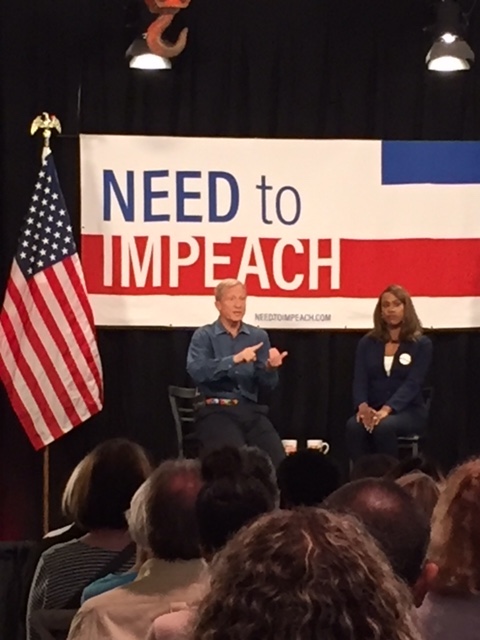
If you’re not aware of Tom Steyer’s “Need To Impeach” petition (and his listed reasons for impeachment), which began last October, we invite you to find out more and considering joining more than 5 million others who have signed his petition calling for the impeachment of Donald Trump. Since Steyer began this journey, he has taken his message on the road to town halls across the country engaging Americans who want to know “what can we do” to stop the lawlessness and corruption of this president. In a recent visit to Minneapolis, Steyer addressed an engaged, informed, and truly frustrated/angry crowd and told them:
Tom Steyer and the ‘Need to Impeach’ petition drive is making stops all across the country.
“When we started this petition drive last October, we knew things would only get worse. We knew there would be events that would happen that would make our case for us. In October, Mr. (Robert) Mueller had not indicted anyone. No one had pled guilty. Then, two weeks ago, the Trump Organization took $500 million from the Chinese government. So, what we’ve seen is a continued deterioration of the rule of law.
“We also know that the political establishment does not want you to be sitting in those chairs tonight. They do not want me to be up here. They don’t want any discussion of impeachment or discussion of holding this president to account because they believe it is not in their interest. And so, we had to think – because there is a lot of criticism of holding this president to account. And we came up with two very simple rules of what we’re going to do.”
To outburst of loud applause, Steyer said, “We are going to tell the truth…and second, we are going to put the American people and American Democracy above anything else. When people say it’s not politically expedient to tell the truth…we’re going to ignore them.
“We’re going to try to show them that the American people have a voice of their own…and it’s a voice that’s very patriotic and respects basic American values. Telling the truth when it’s difficult is the tradition of America that has allowed us to overcome the tremendous difficulties of the last 200 years.”
Steyer acknowledged the need to impeach must be a bi-partisan effort and why so much of his focus now is grass roots organizing to help change Congress on November 6, 2018. It’s up to us, Steyer said to not only “flip the House,” but we must also show both parties that this is the will of the people. “Only patriotic Americans – not an individual party – will make the difference,” he said. “We’re trying to organize so both parties hear this is what the American people want. We’re looking at this as straight-up patriotism, not partisanship.”
Steyer’s advice for now?
Become an active citizen
Sign the petition and ask friends and family to sign
Vote on November 6
Don’t say there’s nothing you can do right now. This is one small step that can help push forward the “need to impeach” this lawless, reckless, and dangerous president.
A Moral Revival
Our political conversation has lacked many things over the past decades. None more obvious than the inclusion of a moral narrative. That’s been changing since the launch of the Poor People’s Campaign: A National Call for Moral Revival on Mother’s Day, May 14.
The Poor People’s Campaign is the nonviolent social change movement aimed at the reviving the core components of Dr. Martin Luther King, Jr’s message of nearly 50 years ago. That is, the oppression of the interconnected triple evils of poverty, racism, and militarism.
The guiding principles of the Poor People’s Campaign include sustained moral direct action as a way to break through the noise and the tweets that surround everything today and to shift the moral narrative. They are bringing together poor and marginalized people from all backgrounds, places, and religions to stand up for their lives and rights by calling for a “revolution of American values.”
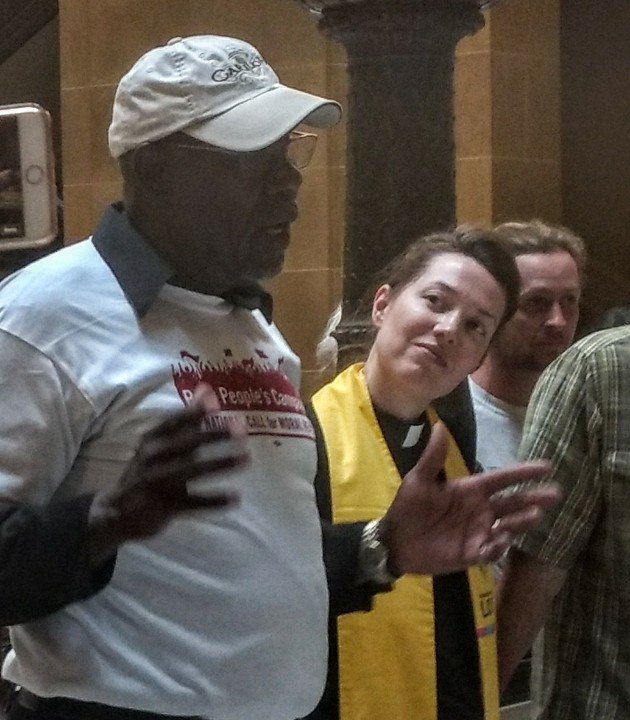
To that end, the Campaign has been waging dozens of protests and civil disobedience across the country, with thousands of civil rights advocates, low-wage workers, and religious leaders leading the way. Their 40 days of protest are aimed at showing the power of people coming together across issues and geography and putting bodies on the line to the issues that are affecting us all. Shown below by the Wisconsin Poor People’s Campaign organizer Wendell Harris who recently told followers at the capitol in Madison, “Don’t let anyone turn you around.”
Wisconsin Poor People’s Campaign organizer Wendell Harris who recently told followers at the capitol in Madison, “Don’t let anyone turn you around.”
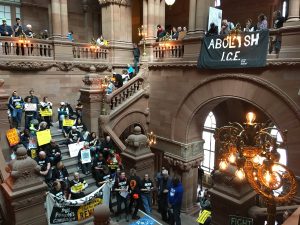
Or this recent group in Albany, NY demanding healthcare and a healthy planet for all.
In New York, the Poor People’s Campaign advocated for healthcare and clean air for all.
Hundreds have been arrested across the country (New York, Washington, Kentucky, Missouri, Iowa, California) and many more events and protests are planned for the rest of June. You don’t have to be arrested, but you can be aware of what’s going on and support the Campaign’s efforts. To find an event near you, click here.
Co-directors of this protest movement are the Dr. William Barber and Rev. Dr. Liz Theoharis. Dr. Barber is a longtime civil-rights activist, and president of the North Carolina NAACP. He is the co-author of The Third Reconstruction: Moral Mondays, Fusion Politics, and the Rise of a New Justice Movement. You can read more on Rev. Barber by clicking here. Rev. Theoharis is the co-director of the Kairos Center for Religions, Rights, and Social Justice. She has worked as an organizer with people in poverty for the past two decades, collaborating with groups such as the National Union of the Homeless, the National Welfare Rights Union, and the Coalition of Immokalee Workers. To read more about Dr. Theoharis, click here.
You can follow the Poor People’s campaign on Facebook and twitter: @UniteThePoor
War rages; plastics are killing our oceans; climate change threatens our very existence. Overwhelming? Yes. Impossible to change? No. But it takes action. What are you doing today to try and stop the insanity?
We can’t all be Tom Steyer or found a Poor People’s Campaign, or be the students from Marjory Stoneman Douglas high school (who are now embarking on a national summer tour to register young voters). But we can each do something. Speak up (to friends, family, legislators). Sign petitions. Support events in your area. Don’t become apathetic. Learn how our government functions. Vote…even when it seems the system is under attack. We cannot give up.
As Howard Zinn (above quote) reminds us: The power at the top is indeed very fragile when we stand up to the bullies.
We’ve flipped the calendar to February. Slowly but surely, we’ll get to November 6, 2018. It may still seem a far off date, but boy are we ready for it!
Mark the date in bold and realize how important it is.
Who among us isn’t tired of the daily chaos inflicted by this current administration and its corporate rulers? Day after day another story sends us spinning to find an escape. We keep hoping Robert Mueller and his investigation will free us. Surely something, somewhere, somehow, someone will free us from this madness.
The short answer is nope. That’s not the way we stop this.
The answer has never been more simple or right in front of our eyes. We have the power to stop this political chaos; we are the ones who can take back control; it is up to us to do the one thing that is becoming increasingly more difficult for many throughout this country – vote. We need to flood the voting booths and the polls on Tuesday November 6, 2018.
There’s an old saying: “Nothing changes if nothing changes.”
We have the power to change this mess.
Having attended the Chicago Women’s March last month there was one and only one message from the plethora of speakers who took to the microphone in Grant Park. It didn’t matter the group they represented. It didn’t matter how long they spoke. It didn’t matter the cause. There was only one message: VOTE. As one speaker simply stated: “Civic engagement has never been more important.”
January Chicago Women’s March: The message was clear – VOTE
And that message was echoed on hundreds if not thousands of signs in the throng of 300,000. Whether the sign said “Fight For $15” or “Stop Trump/Pence Fascist Regime” or “Abort Trump In His First Term” many of them carried a “sub-headline” that read: Vote. Vote Like Your Life Depended On It. Vote, Vote, Vote…everywhere you looked the message was there.
Make no mistake; it’s hard enough to vote in this country with or without Russian “bots” afoot. It’s been proven that Voter ID laws keep people away from the polls. Voter suppression is rampant in almost every state. Electronic, non-verifiable touch screen voting machines can “magically” flip a vote right in front of a person’s eyes. But we can’t let anything deter us…to stop us from going to the polls in November, en masse. The power is within us.
The unending clatter and noise that will surround us must be blocked out. Stay focused. Don’t listen to any polls (be they good or bad). Talk to your neighbors and make sure they vote. Help get people to places so they can secure the necessary voter IDs, volunteer…do something. Turn off the noise machines and mark November 6, 2018 as big and bold as you need to mark it.
If you need a reminder of just how important these mid-terms are, here’s a great article that lists what’s at stake – besides impeaching a president.
Or as comedian and political satirist John Fugelsang tweeted the other day: Voter Apathy is Facism’s lube.
November 6 – it will come as surely as November 7. Don’t lose hope and most importantly, don’t forget the power is within each of us. Why do you think the Founding Fathers began this whole crazy experiment with the words: We The People….
I was surprised this morning when I saw “The British Clare Hollingworth Award” account retweet a retweet of mine. (Boy, how news travels these days). The originator of this activity was the industrious David Sirota, the Senior Editor for Investigations at The International Business Times. Sirota is one of the last bastions – for those of us old enough to remember – of what real investigative journalism looked like.
Sirota had tweeted the following:
The team I work with is very small — just me and 3 reporters. We don’t do hot takes. We do original reporting. Here’s our work over just the last 12 days. I am proud of our team — we focus on breaking real news. These are stories you could find nowhere else. I am tired. Onward.
To my surprise (twitter always finds a way to surprise me), a retweet came from the Clare Hollingworth Award as noted above. I had no idea who Clare Hollingworth was. No time like the present to learn.
One becomes more eager to discover who she was when the headline: The Correspondent Who Scooped the World pops up. In a day and age when women’s voices are becoming stronger and the need for independent journalism has never been more acute, we are happy to pass along a bit of information on this incredible journalist and invite you to go deeper and find out more (see links below). It was even more amazing to learn Clare just recently died on January 10, 2017 – at the age of 105.
In the first week of her career at the British newspaper the Daily Telegraph in 1939, the then 27-year-old Hollingworth broke the news that World War II had started. The Telegraph later recalled:
She witnessed the outbreak of the Second World War on September 1, 1939 when, as a novice Daily Telegraph stringer, she was woken at her hotel in the Polish town of Katowice by the sound of anti-aircraft fire aimed at German bombers.
Opening her window to hear the roar of bombers overhead, she rang the paper’s Warsaw correspondent Hugh Carleton Greene; he was assured by a sleepy official at the foreign ministry that it must be an exercise because talks were still going on.
Next she rang the second secretary at the embassy: “The war has begun.”
“Are you sure, old girl?” he asked.
“Listen!” she commanded, holding the receiver outside the window. “Can’t you hear it?”
In the year leading up to the start of World War II, Hollingworth was in Poland arranging the evacuation of more than 3,500 political and Jewish refugees to Britain, earning herself the nickname “the Scarlet Pimpernel” from Britain’s press. Hollingworth had saved thousands of lives by regularly circumventing British immigration bureaucracy, which due to its heavy vetting process would have left many in the clutches of the Third Reich.
In a male-dominated profession in an era that witnessed women being pushed “behind the lines,” she continued to report from nearly every European and African front during World War II, and she went on to cover the Algerian War (1954–62) and the Vietnam War (1954–75). In 1963, reporting for The Guardian, Hollingworth unmasked Kim Philby as a Soviet agent, and 10 years later she opened a Beijing bureau for the Telegraph.
Her professional determination to dig out world news – from war-torn Europe in the 1940s to Mao’s isolate China in the 1970s – was complimented with compassion for the sufferings of humanity. I dare say, where today in the corporate controlled gate-keeper world of today do we hear that?
It was said of Hollingworth at her 105th birthday celebration: “Clare is a prodigy, one of those extraordinary people who has not recorded history but helped to make it. She was a pioneer among women journalists, and among the first generation of women war correspondents, who proved that they needed no example from men either in reporting gifts or courage.”
Today we mourn the loss of independent journalism around the world perhaps best exemplified in the U.S. by the failure of a strong, impartial corps of journalists who allowed the joke of a 2016 presidential campaign to flourish. For the myriad of reasons given for an election cycle from hell, one cannot understate that one of the key reasons was the breakdown of a functioning, independent media. The failure of basic independent reporting – drowned out by the likes of corporate media giants such as The Washington Post, The New York Times, Fox News, CNN, and MSNBC gave us entertainment and gossip for the majority of the primaries and general election rather than the desperately needed reporting on issues that mattered. With strong independent journalism we would never have heard the term “fake news.”
In honor of Hollingworth’s memory, we invite you to “read more about it” and recall a time when journalists brought us a far more honest view of what was happening on local, national, and international fronts.
Her biography: Of Fortunes and War: Clare Hollingworth, first of the female war correspondents
Clare Hollingworth dies aged 105: Telegraph correspondent who broke the news of World War II passes away in Hong Kong. Click here to read more.
Time’s account of her life written on her 105th birthday: The Correspondent Who Scooped the World. Click here to read more.
A look back by the Independent on her life and work. Clare Hollingworth: Who was the trailblazing journalist who broke WW2? Click here to read more.
And we encourage you to support the efforts of those trying to revive independent journalism – such as those exemplified by Sirota – so that when these bastions of the Fourth Estate become “tired” they have the ability to move “onward.” You can find out more about Sirota’s work by clicking here. David’s twitter account is: @davidsirota
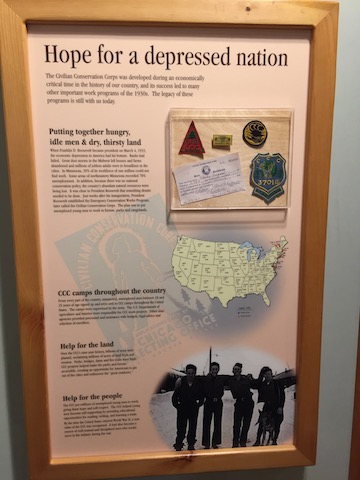
A recent trip to Itasca State Park, in the great state of Minnesota, prompted many thoughts back to the days of the Civilian Conservation Corps, a federal government program started by President Franklin D. Roosevelt in 1933 amid the worst times of the Great Depression. Positive CCC impacts fill this park at every turn, including the Welcome Center with its great exhibits and nod to history. Without the CCC, where would this park or thousands of other national and state parks be?
The Welcome Center at Itasca State Park provides visitors with a great history lesson on the CCC.
Can’t remember exactly what you learned in junior high history about the CCC? As our country once again faces the ravages of destruction to our natural resources and the incredible forces of climate change, what better time to reflect on when we had leadership and willing hands to build “hope for a nation.”
Here’s a short refresher on FDR and the incredible work of the CCC.
FDR established the CCC by executive order on April 5, 1933 shortly after his presidential inauguration in March. It came as no surprise that Roosevelt would focus on something that blended his love of nature with a program designed to put idle hands to work for the common good.
Roosevelt grew up surrounded by outdoor activities, which generated a love of water, forestry, and ornithology. In 1912 as a New York state senator, some of his first legislation introduced centered on bills concerned with forestry and hunting and fishing regulations. In the 1920s, Roosevelt directed conservation camps for boy scouts. And Roosevelt’s slim margin of victory for the New York governor’s seat in 1928 is often credited to his outreach to upstate and rural districts. Some suggest that without farmers, riverkeepers and conservation-minded voters pushing Roosevelt, he probably wouldn’t have been elected governor.
“The forests are the lungs of our land,” Roosevelt once said. And he referred to the CCC as not merely relief workers, but as an army of land healers. In his speech announcing the CCC, Roosevelt said:
“More important, however than the material gains, will be the moral and spiritual values of such work. The overwhelming majority of unemployed Americans, who are now walking the streets and receiving private or public relief, would infinitely prefer to work. We can take a vast army of these unemployed out into healthful surroundings. We can eliminate to some extent at least the threat that enforced idleness brings to spiritual and moral stability.”
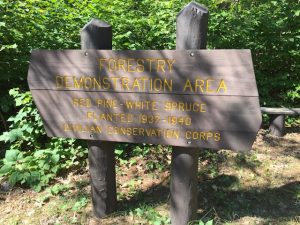
Pine trees planted by the CCC in Itasca State Park bring joy to visitors today. A great conservation legacy.
Within three months of its creation, the Corps had enlisted nearly 250,000 young men. They were assigned to CCC camps around the nation. During its nine-year existence, the CCC employed nearly three million young men. It planted over two billion trees, fought forest fires, built trails, campgrounds, and reservoirs, and aided with soil conservation programs. The CCC became one of the New Deal’s most popular and successful programs.
The CCC was considered to be the greatest peacetime mobilization ever of American youth. CCC workers were taught four basic skills:
How to plant trees
How to cut firebreaks
How to control wildfires
How to protect wildlife
The CCC was responsible for the recreational building of the Shenandoah National Park as well as for the preservation of the Joshua trees in Southern California. CCC workers helped to stop shoreline erosion in the Carolinas, and every state in the nation benefited from their work. In Utah, for example, CCC projects included improving grazing conditions on rangelands, conserving water, controlling rodents and constructing hundreds of miles of fences and guardrails along large water diversion damns. The CCC was crucial to establishing the first state parks in Virginia, West Virginia, South Carolina, Mississippi, and New Mexico.
They built service roads, sewers, water and electrical systems, bridges, footpaths, restrooms, and new campgrounds. In Itasca State Park in Minnesota, for example, the CCC built the beach at the public swimming area by bringing in the sand (how in the 1930s does one bring in enough sand to create a beach?) and placing it on the ice covered waters in the middle of winter. Then when the ice melted in spring, the sand sank and created a beach still in use today.
Eleanor Roosevelt, greatly dissatisfied that women were being kept out of the CCC, fought mightily for female workers to be part of the CCC. But only 8,500 women participated in the program from 1933-1942, compared to the nearly three million men. Similarly, Native Americans and African America workers were included, but at disproportionate numbers.
As the U.S. moved into wartime activation in the 1940s, the CCC camps came to a close with little fanfare. Yet the work done by the CCC workers in public forests and parks remained as a proud reminder of what we can do when we pull together for the betterment of our species and the world in which we live.
What About Today?
Even FDR’s CCC alone cannot fix the planetary environmental crisis we face today. We were warned decades ago about the ravages such as Hurricane Harvey that awaited us – and we chose to ignore them. But by remembering the past efforts of those like the young men and women of the CCC, we can find our own story to create for the 21st century protection and enrichments of our lands.
We do not have to sit idly by as we watch what is going now with the White House’s efforts, led by Interior Secretary Ryan Zinke, to reduce the size of our national parks and open them for mining and drilling in Utah and Nevada. Nevada Senator Martin Heinrich recently urged rejection of this plan, noting, “These national monuments were the culmination of decades of advocacy from a broad coalition of local businesses, sportsmen, tribal and Hispanic leaders, veterans, faith leaders, and many other community members across New Mexico who have long recognized the national treasures in their backyards and knew they should be conserved for future generations to enjoy.”
Hunters can play an active part to help preserve our land. In a recent article bemoaning the pheasant-hunting outlook in South Dakota it was noted: “South Dakota’s biggest challenge to remain a mecca for visiting ring-neck hunters is to halt conversion of grassland into cropland. A study found 1.84 million acres or about 37 percent of the grassland pheasant habitat in the state were lost primarily to conversion to cropland from 2006 to 2012.”
Take a look for example what they are doing in London. Planting trees, not only good for the environment, but good also for the economy.
What would a CCC look like in the 21st century? Different of course, but the core elements would remain the same. It would teach us the importance of conservation; our inter-contentedness to all living things; a respect for nature.
We have seen great outpouring of our generosity of spirit to help those in need after the ravages of Hurricane Harvey. But there is another proactive way we can help our fellow citizens. Pay attention, fight for the environment, and tell the stories of the past to remind people that yes, when we come together for the common good, we do great things. We owe it to FDR and the CCC to keep the flame of hope alive in the 21st century.
Listen to a brief recording of FDR’s CCC speech:
A Great Resource For Finding Out More
In addition to making sure you read brochures and displays at your state and national parks about the great work done by the CCC, we encourage you to pick up New York Times’ best selling author Douglas Brinkley’s tome, Rightful Heritage: Franklin D. Roosevelt and the Land of America.
The book focuses on FDR’s great love for the natural world, which started in his youth and followed throughout his political career. Wildlife restoration, emphasis on the national parks, soil conservation, migratory bird protection, hunting and fishing conservation – and dare we forget the duck stamp. All of these are FDR’s conservation and ecology legacy.
It covers more than just the CCC (although the book serves as a great chronicle of this important program). Described as an “epic chronicle,” Rightful Heritage presents a unique portrait of FDR and “illuminates the tension between business and nature – exploiting our natural resources and conserving them.”
A great read for anyone interesting in “learning more about it.”
“Of all the forms of inequality, injustice in health is the most shocking and inhuman.”
–Martin Luther King, Jr.
Anyone who has read us, followed us, or interacted with us since we opened our doors as Wisdom Voices Press, knows we have been strong advocates for a single payer health care system in this country. We have written extensively about it; we have supported candidates who pushed for it; we marched in support of it; and we have tried non-stop to educate others about it through our blogs and interviews. Click here for a complete list of our features and interviews.
A single payer or “Medicare For All” healthcare delivery system is the only viable plan.
We watched the dreadful display in Washington over the past six months as Republican elected officials tried to take health care access away from millions (thankfully, losing in the end). Now, it’s becoming clearer each day that the next stop on the U.S. health care delivery train will be single payer. Single payer, which guarantees health care as a human right, as done in every other educated country on the planet.
Oh, it won’t be without continued struggle (far more than should be needed for the obvious answer to our current fractured health care delivery system that leaves so many uninsured and underinsured). Single payer advocates watched as a promising effort to implement a “Medicare For All” policy in California recently failed after both Democratic houses of the legislature passed it. The Democratic Speaker of the House, refused to move the bill forward for a vote. It’s come close in Vermont too, but was never able to get over the finish line. Corporate controlled (state and national) representatives from both parties run from talk on single payer faster than just about any other topic.
But today, those who used to complacently smile at single payer advocates as if to say, “silly you, it will never happen” or those that hem and haw about tweaks to the current system, know as well as the heads of the for-profit insurance companies – single payer is on its way. Single payer is now predicted and supported by the likes of former President Jimmy Carter to billionaire Warren Buffet. And Representative John Conyers, who has introduced single payer legislation for years with his HR 676, has seen a flurry of his Democratic house members cosign the bill this year.
More importantly, the public is demanding single payer legislation. A recent Pew Research Center poll indicated:
Currently, 60% say the federal government is responsible for ensuring health care coverage for all Americans, while 39% say this is not the government’s responsibility. These views are unchanged from January, but the share saying health coverage is a government responsibility remains at its highest level in nearly a decade.
Then there’s always common sense. What else is left? The Affordable Care Act after all was the Republican Plan. Formulated in the Richard Nixon era, developed by the Heritage Foundation, and implemented by Governor Mitt Romney in Massachusetts. Or ask yourself, why do we have insurance companies? Are they doctors, nurses, physical therapists, mental health providers? No, they are middlemen and nothing else.
Similar to every other social-change legislation, the push will not come from the top down. It will be up to the grass roots to demand it and to elect candidates committed beyond measure to implement it. So, we recommend that you learn as much about it to educate others about what it is and what it isn’t.
Or to quote that old advertising slogan: You’ve tried the rest; now try the best.
Learn More About Single Payer
There is no better starting point than Physicians For A National Health Program’s web site. Their opening paragraph: “Single-payer national health insurance, also known as “Medicare for all,” is a system in which a single public or quasi-public agency organizes health care financing, but the delivery of care remains largely in private hands. Under a single-payer system, all residents of the U.S. would be covered for all medically necessary services, including doctor, hospital, preventive, long-term care, mental health, reproductive health care, dental, vision, prescription drug and medical supply costs.”
Read HR 676 and urge your congressional rep to sign off if they have not yet done so.
Know the difference between the “public option” and single payer. Read what National Nurses United’s RoseAnn DeMoro has to say on that topic.
Watch FixIt: Healthcare At The Tipping Point and engage your local business leaders to push for single payer as an economic necessity for their business.
Engage, engage, engage. It’s up to us to be the change we want to see. We started in January with the Women’s March and have continued non-stop with healthcare demonstrations and showing up at town halls. Don’t stop. Democracy after all is about We The People, not We The Corporations. Read LeeAnn Hall’s (People’s Action) piece on how people, not politicians, beat the healthcare repeal bill.
The American Mercy Tour
One of the great benefits of working within the single payer advocacy movement is meeting and getting to know the great people who will never give up until “Medicare For All” is enacted in this country. One of the best of the best is actor Michael Milligan. His award winning play, Mercy Killers, and his newest venture, Side Effects, takes a look at changing hearts through dramatic presentation and story telling.
He has now combined efforts into the “The American Mercy Tour” which will be playing in Chicago September 7 through October 8 at the Greenhouse Theater Center.
When we first talked with Michael back in 2012 as Mercy Killers was premiering, he told us: “I was trying to take what people read or what they see in the news about health care but I wondered how do you translate that to the human component so that it would really spark their empathy and outrage (at our current health care system).”
In Mercy Killers, Joe, a blue-collar red state auto mechanic, faced with his wife’s failing health must grapple with the stark divide between his values and his reality. Pushed to the breaking point by debt, disease and a busted system, Joe must decide what compromises he will make to keep his wife alive. Mercy Killersis all at once a tender love story and an unblinking look at those the system leaves behind.
Flipping to the other side of the stethoscope, Side Effectsfollows William, a family practice physician on the brink of burnout. Caught between his ambition to become the healer his father once exemplified and the corporatization of his chosen profession, William must reconcile the art and business of medicine, or be forced to lose his practice. In this Chicago premiere, we see the human side of those who heal us, throwing light onto the turmoil that remain out of sight from the examination table.
If you’re in the Chicago area or have friends or family there, these plays offer a way to begin the conversation with anyone on the need for healthcare as a human right. For more information, click here.
It isn’t often we find ourselves at a loss for words, but as we close out 2016, we feel what more can be said that hasn’t already been said. We stand at the brink of unchartered waters and wonder – as much as anyone – what will happen as 2017 dawns. We have no predictions, no for-sure remedy’s, no assurances that all will be well in the short term.
Gathering in large numbers for peaceful, non-violent protest will be key.
So we decided to make our last newsletter of 2016 one that reflects on the many people we have talked to or written about since we began this journey. The struggle continues, the fight does not end and we take solace in history – a reminder that the only way out is through.
We urge you in the days ahead to:
Resist (even if all is well for you, millions of your neighbors suffer and will suffer more if proposed policies are enacted to cut Medicare and Social Security)
Re-Educate (it didn’t used to be like this. Remind yourself and others that we lived in a time when government worked – not perfectly, but it did work)
Renew Your Commitment (do something; write a letter, talk to a neighbor, support those on the front lines of peaceful, non-violent protest).
In hopes of staying inspired, we highlight just a few of the great fighters for progressive values we have talked with over the years – or others from history – who remind us to never give up – no matter what the odds. We’ve linked to our individual features (and the dates first published) if you would like to read more about them.
Mother Jones – 2015: The tiny but powerful figure of Mother Jones, typically clad in a black dress, her face framed by a lace collar and black hat, stared down company goons with guns, encouraged fearful strikers whose resolve would falter during month-long strikes, and went toe-to-toe with the powerful politicians of her day.
Mary Jones lost her four children and her husband to a yellow fever epidemic after the Civil War. No surprise that she made children and their plight part of her fight for better living conditions.
She turned her personal sorrow into a struggle to help others…Yet, she never lived to see the official organization of the steel workers, which did not come until the mid-1930s. After the failed strikes of 1919, she wrote, “A day will come when the union banners will wave in triumph over the still mills. Not in my lifetime, for my days are almost over…but surely in yours. Do not give up hope!”
David Bender 2013: “As long as the institutional levers of power are controlled by the military and intelligence community and contractors and the corporations that are doing billions if not trillions of dollars worth of business and who set public policy based on their agendas and not that of the American people, nothing will change. That’s what I see as the challenge. That means we have to come up with a new way of dealing with this. We have to find ways for people to use the power they have—the power of the ballot is not what it once was. In fact, voting has become more theater than substance. We need to find a way to harness the power of the American people and the power they’ve got is strength in numbers, which can overwhelm the likes of the Koch Brothers, no matter how much money they have. The Koch Brothers can influence public policy but they cannot buy 300 million people. They can distract them; they can mislead them; they can pay for networks like Fox News but they cannot buy the people. And where I see the future and hope is that ultimately through this new technology with a platform like we have with Progressive Voices, we’re going to reach the next generation and they’re going to recognize something that Europeans have recognized for a long time. When Europeans have a situation in which workers’ rights are taken away—as they were in Wisconsin—they stop working. When consumers see a situation in which they are being exploited by large corporations who double and triple oil prices, then the only power you have collectively—if we were to harness it—is to simply tell those corporations ‘no.’ You don’t have our money. We are not going to buy your products; we aren’t going to participate in whatever this anti-union, anti-worker system is.
“In Europe it’s called a general strike. But what it allows people to do is vote with their pocketbooks. That collectively is the power we have. They can manipulate and buy our influence through the electoral process; they can’t make us spend money. What we need to do—through platforms like Progressive Voices—is to say the enemy is not government. We have to strengthen government to bring these people down. We have to break up these concentrations of wealth that have such influence over public policy; we have to reverse Citizens United; we have to reverse Buckley v. Valeo (money is speech) and that’s going to take a generation or two.”
John Ryan’s Living Wage, written in 1906
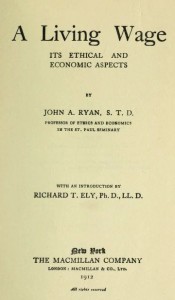
John A. Ryan 2013 and the origins of a “Living Wage”: Considered to be the foremost social justice advocate of his day (early 20th century), Ryan argued that every person, because they are “endowed by nature or rather by God, with the rights that are requisite to a reasonable development of his personality,” has a natural right to share in the earth’s products. The primary natural right to subsist on the bounty of the earth exists at all times; in an industrial society that right takes the form of a living wage. Subsistence, a bare livelihood, is the product of man’s right to life; a “decent livelihood” is demanded by man’s dignity.
Robert Koehler – 2013: Defending peace – “9/11, Bush, the war on terror — these things have shattered the national soul. This is the new normal — an Orwellian permanent war, now hardly more than background noise. This sort of thing I never, of course, foresaw in my younger days. Now the quest for peace has intensified in urgency tenfold or a hundredfold. Human civilization is unraveling environmentally, politically, culturally, spiritually. A warped economic system depends on war: the military-industrial complex, the prison-industrial complex. We have a system that requires enemies, that weeds people out. To hear the stories of those who are on the wrong side of the divide, whether at home or abroad is so heartbreaking, but what it has done is open up the urgency of peace like never before — the urgency of learning how to build a new sort of society, based on connectedness, the Golden Rule.”
John Bonifaz – 2013: “I don’t want to diminish the enormous amounts of grass roots political power we saw in this last election cycle,” he added. “There were a lot of efforts to fight back against the power of big money. But the underlying theme here is that big money has an enormous influence disproportionately in our political process today and unless we restore democracy to the people, unless we allow for Congress and the states through a constitutional amendment to set reasonable spending limits on campaign finance and make it clear that corporations are not people, the matters are only going to get worse.”
Fighting for economic and social justice is nothing new for Sister Simone and NETWORK, a 40-year-old organization.
Simone Campbell – 2012: “The struggle right now is for the soul of our nation. Are we going to continue to be fearful individuals who don’t look out for one another? Frankly, only rich people can pander to individualism because poor people know you have to work together. You have to cooperate. We found much more community among low-income people, where our sisters work than even what we found even in our ‘friend raisers’ where we found middle class folks who felt so isolated and adrift. The response to our bus tour was so overwhelmingly positive. It was awesome. The $64,000 question of course is, what happens next?”
Wendell Potter – 2012: “Be skeptical about what you hear. Know that almost everyone you hear expressing a point of view has an agenda. Don’t outsource your thinking to TV commentators. Take the time to try and educate yourself. We all lead busy lives, but educating yourself is important. Think beyond yourself. Think about your children and the kind of world we’re creating for them. It’s important to spend a little time to get informed before you pull a voting lever.”
Brad Friedman – 2011: “The systems we use for voting are absolutely insane and the fact that it’s not considered a problem is insane. And if you look back to Watergate, which was an undermining of our system of democracy, it is so much easier now than it was during Watergate to do just that. You now have one person, who with a few keystrokes on a computer can flip the results of an entire election with no possibility of ever being detected. It’s just that easy.”